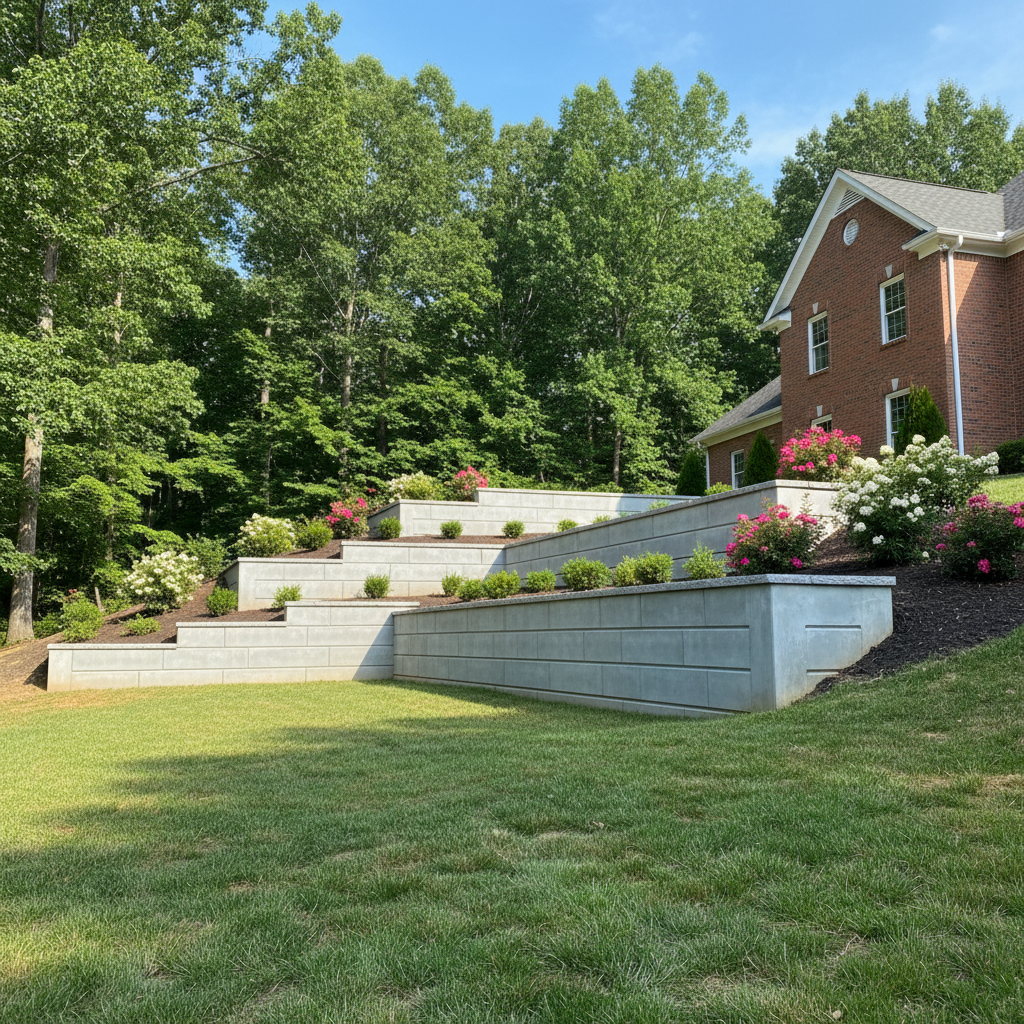
You need a retaining wall. Maybe your yard slopes too much, or you're trying to reclaim some usable space. A good concrete retaining wall can be a real game-changer for your property here in Lenoir. But I've seen my fair share of folks make some pretty common, and often costly, mistakes when they're planning or hiring for these projects. Let's talk about what to watch out for.
Mistake #1: Not Understanding Drainage (The Big One)
This is probably the biggest blunder I see. People focus on the wall itself and completely forget about what's happening behind it. Water is powerful, and if it's not managed right, it'll turn your beautiful new wall into a leaning tower faster than you can say "erosion."
No Backfill Drainage: You can't just pile dirt right up against the back of the wall. You need a layer of gravel or crushed stone directly behind it to allow water to drain freely. Without it, hydrostatic pressure builds up, pushing against the wall. That's a recipe for cracks and bowing.
Missing Weep Holes or Drain Pipes: Even with gravel, water needs somewhere to go. Weep holes (small openings in the wall) or a perforated drain pipe (often called a French drain) at the base of the wall are absolutely critical. They let that collected water escape instead of pushing on the wall.
Ignoring Surface Runoff: Think about where the water comes from. Is your neighbor's downspout dumping right onto your new wall? Is there a natural swale that directs a torrent of water towards it during our heavy summer thunderstorms? You might need to regrade the area above the wall or install a swale to divert that surface water away.
Seriously, if your contractor isn't talking about drainage in detail, that's a huge red flag. Walk away.
Mistake #2: Skimping on the Foundation
A retaining wall is only as good as its foundation. This isn't like building a little garden bed; these walls are holding back tons of soil. You need a solid, level footing that extends below the frost line.
Here in Lenoir, especially with our clay soils in some of the older neighborhoods like College Avenue, you can't just plop a wall on top of loose dirt. That footing needs to be properly excavated, compacted, and often reinforced. If the ground underneath shifts, your wall will shift. It's that simple. Don't let anyone tell you a few inches of gravel is enough for a significant wall.
Mistake #3: Going DIY on a Big Project
I get it, you're handy. You've watched some YouTube videos. But a retaining wall over a few feet tall, or one holding back a significant slope, isn't a weekend warrior project. There are engineering considerations, soil mechanics, and heavy lifting involved.
Trying to DIY a large wall often leads to: wasted materials, a wall that fails, or worse, injury. For anything substantial, you really need a professional. We've seen plenty of attempts that ended up costing more to fix than if they'd just hired Coastal Concrete Co. to do it right the first time.
Mistake #4: Not Checking for Permits or Utility Lines
Before any digging starts, you need to know what's underground and what the city or county requires. Digging into a gas line or a main water pipe isn't just expensive; it's dangerous. Always call 811 before you dig, every single time. It's free and it could save your life.
Also, check with the City of Lenoir's planning department. Depending on the height and location of your wall, you might need a permit. Ignoring this can lead to fines, or being forced to tear down a wall you just built.
Mistake #5: Choosing the Wrong Material or Contractor
While I'm a concrete guy, I'll tell you there are different materials for retaining walls. Concrete blocks, poured concrete, timber, natural stone – they all have their pros and cons. Make sure the material you choose is appropriate for the wall's height, the soil conditions, and your budget. Poured concrete, for example, offers incredible strength and versatility, especially for taller walls or those with complex curves.
And for the love of all that's holy, don't just pick the cheapest bid. Get multiple quotes, but more importantly, check references. Ask to see examples of their previous retaining wall work. A good contractor will be happy to show you. Someone who's vague about their experience or rushes through the estimate without asking detailed questions about your property and drainage? That's another big red flag.
A retaining wall is a significant investment in your property. Do your homework, ask the right questions, and don't cut corners. It'll save you a lot of grief and money in the long run.