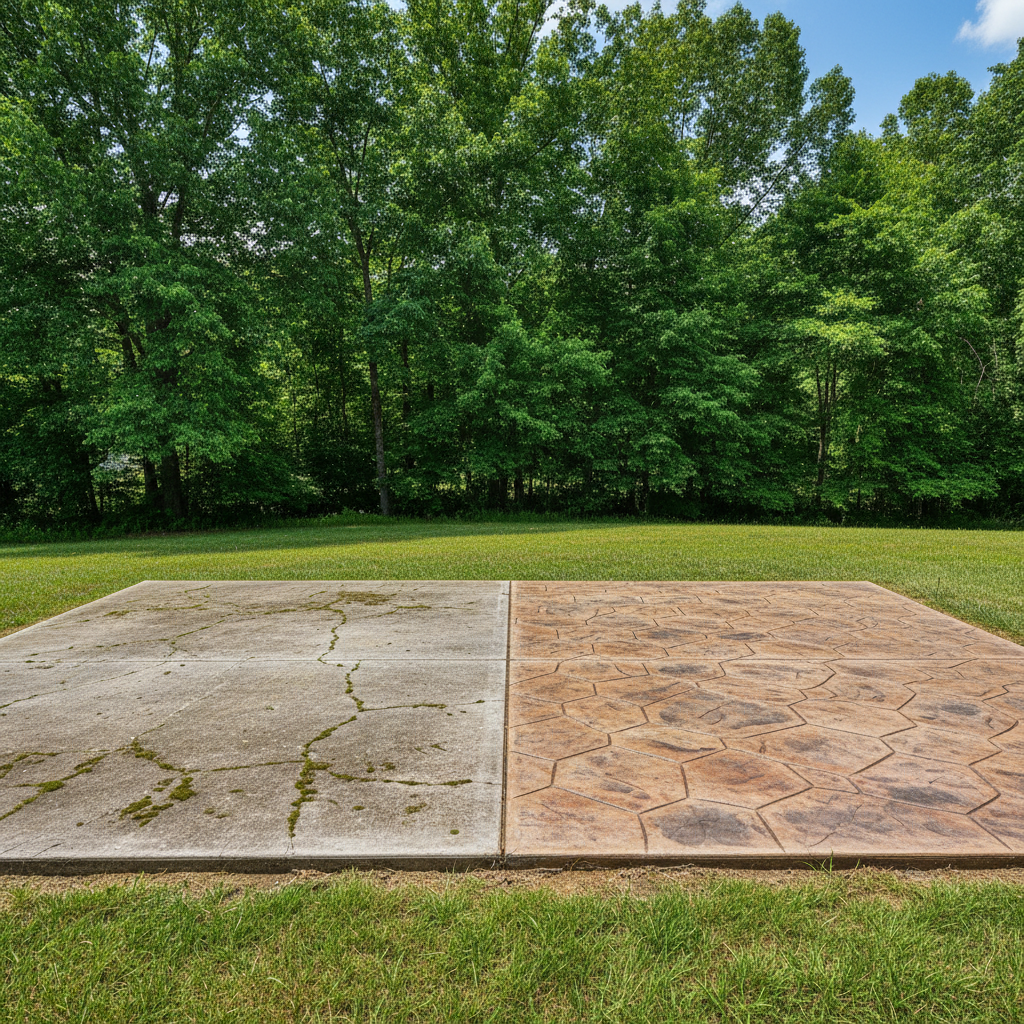
So, you're eyeing up stamped concrete for your place here in Lenoir. Smart move. It's a great way to get that high-end look of stone or brick without the crazy cost or maintenance. But once you decide on stamped, you've actually got another big decision to make: are we talking about a brand-new concrete pour that gets stamped, or are we putting a stamped concrete overlay on top of existing concrete?
A lot of folks don't even realize there are two distinct ways to get that stamped finish. They both have their pros and cons, and what's right for your neighbor might not be right for you. Let's dig into it.
New Pour Stamped Concrete: The Foundation First Approach
This is what most people picture when they think of stamped concrete. We come in, excavate the area, lay down a proper sub-base, put in rebar or mesh for strength, pour fresh concrete, and then, while it's still wet, we apply color hardeners and release agents, and press those stamping mats into the surface. Once it's cured, we clean it, seal it, and you've got a beautiful, brand-new surface.
Cost:
Let's be honest, this is usually the more expensive option upfront. You're paying for all the groundwork, the materials for a full slab, and the labor to pour and stamp it. There's more material and more steps involved than just an overlay. For a patio or driveway, you're looking at a significant investment, but you're also getting a brand-new foundation.
Durability:
This is where new pour stamped concrete really shines. When done right, with proper compaction of the sub-base, good concrete mix, and appropriate reinforcement, it's incredibly durable. It's a solid slab, built from the ground up to last. Here in Lenoir, with our freeze-thaw cycles in the winter and sometimes shifting clay soils, a well-prepared new pour handles those stresses much better than an overlay ever could. It's designed to be a long-term solution, often lasting decades with proper care.
Maintenance:
Maintenance is pretty straightforward. You'll need to clean it periodically – just sweeping and occasional washing with a hose. The most important thing is resealing it every 2-5 years, depending on traffic and sun exposure. That sealer protects the color and the surface from wear and tear, and it makes it easier to clean. If you skip the resealing, you'll notice the color fading and the surface becoming more susceptible to stains.
Appearance:
With a new pour, you have the ultimate flexibility. You can choose any pattern, any color combination, and really customize the look. The depth of the stamp is usually more pronounced because you're pressing into a fresh, thick slab. The finished product looks incredibly authentic, whether you're going for natural stone, brick, or even wood plank textures. The color is integrated into the top layer of the concrete, giving it a rich, consistent appearance.
Stamped Concrete Overlay: The Resurfacing Option
An overlay is different. Instead of tearing out existing concrete, we prepare the old surface – clean it thoroughly, repair any cracks or spalling, and then apply a thin layer (usually 1/4 to 3/4 inch thick) of a special polymer-modified cementitious material. While this thin layer is still wet, we apply the color and stamp it, much like a new pour. It's essentially a new surface on top of an old one.
Cost:
Generally, an overlay is less expensive than a new pour. You're saving on demolition, excavation, and the cost of a full concrete slab. If your existing concrete is in decent shape – meaning it's structurally sound with no major heaving or settling – an overlay can be a very cost-effective way to get that stamped look without breaking the bank.
Durability:
This is the trickiest part with overlays. Their durability is directly tied to the condition of the existing concrete underneath. If the old concrete is cracked, heaving, or has significant structural issues, an overlay is just putting a band-aid on a bigger problem. Those underlying issues will eventually telegraph through the overlay, leading to cracks, delamination, or spalling. Even on good concrete, an overlay isn't as robust as a full slab. It's thinner, so it's more susceptible to impact damage or wear in high-traffic areas. I've seen overlays look great for years, especially on a porch or low-traffic patio, but they generally don't hold up as long as a new pour, especially on a driveway or in areas with heavy foot traffic.
Maintenance:
Maintenance is similar to a new pour: regular cleaning and resealing every 2-3 years. Because it's a thinner layer, I often recommend sealing overlays a bit more frequently to protect them. You'll also want to keep an eye out for any small chips or delamination, which can sometimes be patched if caught early.
Appearance:
Overlays can look fantastic. The range of colors and patterns is just as broad as with a new pour. The depth of the stamp might be slightly less pronounced due to the thinner material, but it's still very effective. The key is that the existing concrete needs to be relatively flat and even for the overlay to look its best. If you've got a lot of unevenness underneath, it can be harder to get a perfectly consistent stamped pattern.
Which One Should You Choose for Your Lenoir Home?
Here's my take, especially considering our local conditions. If you're starting from scratch, or if your existing concrete is cracked, severely spalled, or has noticeable settling issues – especially if it's an older slab that's seen a lot of Caldwell County winters – then a new pour stamped concrete is almost always the better choice. It's the long-term solution, built to withstand our climate and give you the most durable, worry-free surface for decades.
If your existing concrete is in really good shape – maybe it's just plain gray and boring, but it's solid, level, and only has minor hairline cracks – then a stamped concrete overlay can be a fantastic, cost-effective option. It's perfect for giving an old, sound patio or walkway a beautiful facelift without the extensive demolition. Just know its lifespan won't quite match a new pour, and you'll need to be diligent with that resealing.
Ultimately, it comes down to what you're starting with and what your budget and expectations are. At Coastal Concrete Co, we always come out, take a look at your specific situation, and give you an honest recommendation based on what we see. We'll tell you if an overlay is a good fit or if you're just throwing good money after bad. We want you to be happy with your concrete for years to come, not just for a season.